The practical layer
Keeping family paperwork in order across two homes
The paperwork problem in a shared family is not storage. It is knowing, at half past six in the morning, which house the passport is in.
On this page
- The real problem is location, not filing
- The five categories worth separating
- Forms that need a signature
- How long to keep things
Published 18 August 2026.
01 The real problem is location, not filing
Most households can find a document eventually. The difficulty in a shared family is that the search space has doubled and the person searching is often not the person who filed it.
The fix is a single agreed rule for each category of paper, written into the parenting plan so that it is not renegotiated every time. One home holds the passport. One home holds the medical record card. School letters are photographed and sent the day they arrive. That is most of the problem solved.
Where a rule is genuinely awkward, write down the exception rather than leaving it to memory. Exceptions that are unwritten always come back as arguments.
02 The five categories worth separating
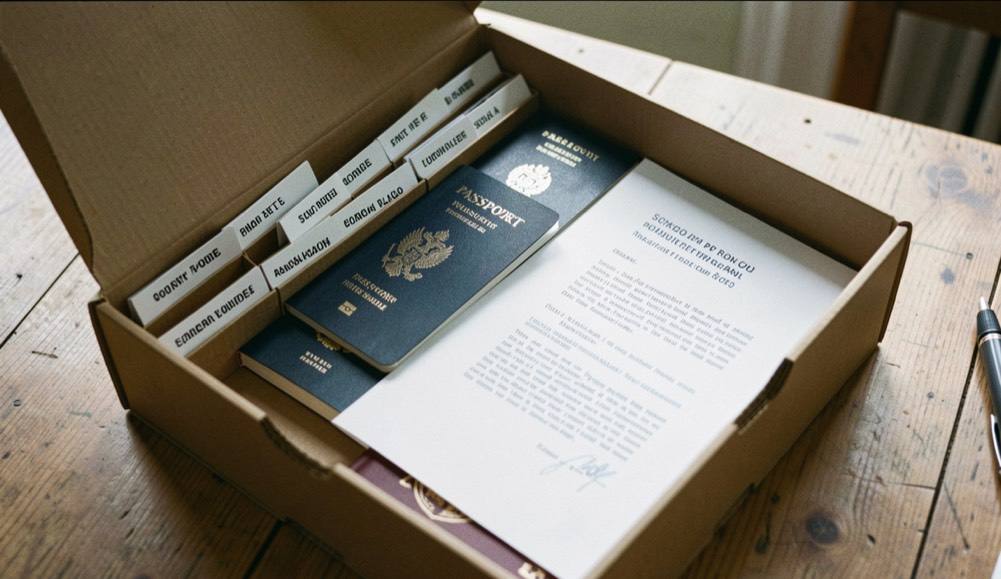
Identity documents come first: passports, birth certificate copies, and anything with a photograph. These should have one home, one place in that home, and a note in the other house saying where they are.
Health papers next: the red book for younger children, immunisation records, hospital letters, any care plan for an ongoing condition. School papers third: term dates, reports, letters requiring a signature, anything with a deadline. Then activities: club memberships, kit lists, fixtures. Then money: anything either household may need to refer to later.
| Category | Where it lives | What the other home holds |
|---|---|---|
| Identity documents | One agreed home, one agreed place | A note saying where, and a photocopy |
| Health records | The home that usually books appointments | A photograph of the current pages |
| School letters | Wherever they arrive | A photograph, sent the same day |
| Activities and kit | Split by which home does which activity | The kit list only |
| Money and receipts | Each home keeps its own | The monthly summary |
03 Forms that need a signature
School trip forms, medical consent and club registrations tend to arrive with a deadline that has already half expired. Photograph the form the day it appears and send it, rather than waiting for the next handover, and note the deadline in the shared calendar as soon as it is known.
Agree who signs which sort of form and stick to it. A form signed twice causes as much trouble as a form not signed at all, and school offices remember both.
Where a form asks who to contact, put both households on it if the school allows. It removes an entire class of problem later in the term, and it is one of the practical points covered in school life across two homes.
04 How long to keep things
Most school paperwork is dead within a term. Reports are worth keeping, letters are not, and a household that keeps everything ends up with a box nobody can search. Clear the school folder once a year, at the end of the summer term, and keep only the reports and anything with a legal or medical function.
Health records are the exception and should be kept indefinitely, along with anything relating to a condition that may need a history later. Identity documents obviously stay.
A single annual clear out, done at the same time as the plan review, keeps the whole system honest. The rest of the household habits that support it are in small habits that steady a shared week.
More like this
Two homes