The shared week
A shared family calendar that both homes can trust
A calendar only works if both households believe it. Getting to that point takes three habits and about an hour of setting up.
On this page
- One calendar, not two
- What to load into it
- The three habits that make it stick
- Handling clashes without drama
Published 25 August 2026.
01 One calendar, not two
The commonest failure is a household that keeps its own calendar and copies across the bits that concern the other. Copying is where things get lost, and the item that gets lost is always the one that mattered.
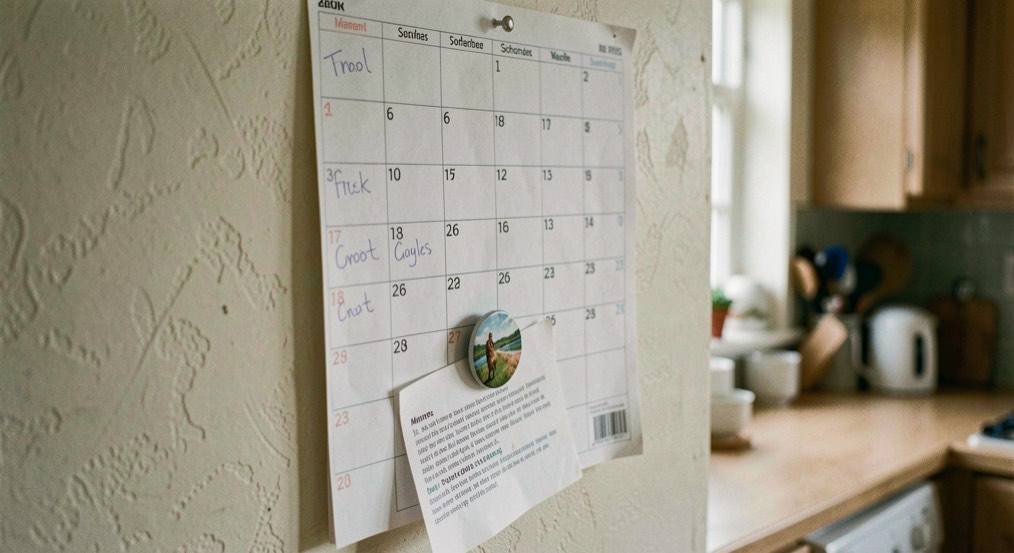
A single shared calendar removes the copying step. It does not need to be sophisticated. A shared digital calendar with two writers works well. So does a paper calendar on each kitchen wall, updated at the same moment on a Sunday evening. The technology is much less important than the agreement that there is only one authoritative version.
Whatever you choose, it should be readable by a child old enough to want to know what is happening on Saturday. A calendar that only adults can decode ends up being asked about instead of read.
02 What to load into it
Start with the school year. In Britain that means term dates, the half terms, inset days and the two or three fixed events per term that require an adult to be somewhere at a particular time. Schools publish these a long way ahead and almost nobody enters them early enough.
Then the pattern from the plan: the ordinary week, marked far enough forward that a booking clash is obvious months out. Then medical and dental appointments, clubs and the away fixtures that eat a Saturday.
Leave out anything that is not a commitment. A calendar filled with intentions stops being a record of what is actually happening, and once that happens people go back to asking.
| Layer | What goes in | When to enter it |
|---|---|---|
| School year | Terms, half terms, inset days, fixed school events | As soon as the school publishes them |
| The pattern | The ordinary week from the written plan | A full year ahead |
| Appointments | Dental, medical, clubs, fixtures | The day they are booked |
| Holidays | Weeks away, travel days, who is where | At the spring review |
03 The three habits that make it stick
First, enter things immediately. The gap between booking an appointment and writing it down is where the double booking is born. Ten seconds at the reception desk saves a difficult Thursday.
Second, look at the fortnight ahead once a week, at the same time. Sunday evening suits most households because it is close enough to the week to be useful and far enough from Monday to fix something.
Third, do not editorialise in the entries. A calendar item should say what is happening and where. Commentary about who arranged what belongs in conversation, not in a field that both households read every Sunday. That is the same discipline that makes short written messages work.
04 Handling clashes without drama
Clashes are normal. A shared calendar does not prevent them; it makes them visible early, which is the whole point. The useful rule is that the calendar reports the clash and a short conversation resolves it, in that order.
Agree in advance what generally wins. Most households settle on something like: fixed school commitments first, then medical appointments, then a child's own regular activity, then adult plans. Having that order written into the parenting plan means the conversation is about this particular Saturday rather than about principle.
When a change is agreed, the person who proposed it enters it. That single convention prevents the situation where both households believe the other has updated the record, which is how a child ends up waiting at a school gate.
More like this
Co-parenting