The shared week
Paperwork that works in two homes
Which details change when a family runs across two addresses, where to keep the folder, and how both homes hold the same version of every form.
01 Which details actually change?
Two addresses mean two versions of every detail, so the rule is simple: one folder, one master copy, and one person who updates it. Decide which address counts as the main one for post, keep the folder there, and tell the other home where it is. Everything else follows from that single decision.
Most of the form stays the same. The child's name, date of birth and school do not move. What changes is the address block, the contact number, and sometimes the person named as the second contact.
Start by listing the fields that carry an address. School records, the GP surgery, the dentist, the passport office, the bank, and any club or activity your child attends. Each one holds its own record, and each one needs the same correction.
Then list the fields that carry a phone number or an email. These matter more than people expect. A form sent to an old number is a form that never arrives, and a letter sent to the wrong house can sit unopened for weeks.
A useful habit is to write the change once, on a single sheet, and copy it from there. Name, date of birth, new address, date the change takes effect, and the reference number of the account. Five lines. Every organisation asks for roughly the same five lines.
If one of the two homes is in France, the vocabulary shifts. French family administration uses its own terms for housing benefit and family allowances, and a household moving between the two systems meets them quickly. A practical French-language magazine for families, family paperwork in France, sets out how those requests are prepared and which documents are usually asked for. Reading it before you fill anything in saves a second round of letters.
02 Where should the folder live?
One physical folder, in one house. Not a folder in each home, because two folders drift apart within a term.
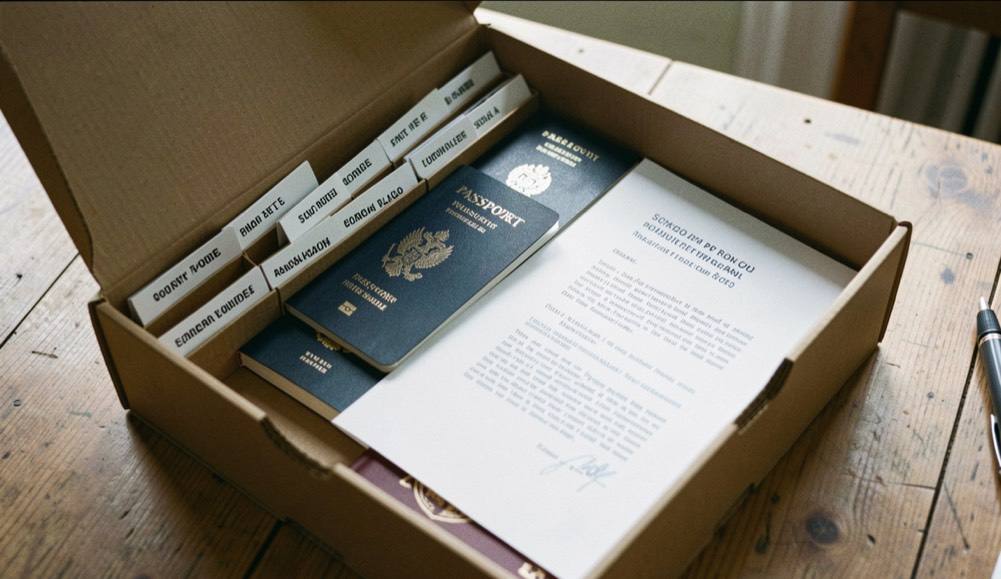
The folder lives in the home where the post arrives. That is usually the address you gave the school and the surgery. Keep it in the same place every time: a shelf by the door, a drawer in the kitchen, a box on the desk. The place matters less than the fact that it never moves.
Inside, use four sections. Identity documents. School and health. Money and benefits. Everything else, which is where the odd letters go.
Add a single sheet at the front. It lists the current address, the current phone numbers, the school, the GP, and the date each record was last updated. Anyone opening the folder sees the state of things in ten seconds.
The second home keeps a slim copy. Not the originals. A photocopy of the front sheet, plus the two or three documents that get asked for most often. If the second home is a long drive away, that copy is what stops a weekend turning into a paperwork trip.
03 How do both addresses keep the same version?
Pick one person to hold the master copy. It can be either parent, but it should be one, not both. Two people updating two folders is how versions split.
When something changes, that person writes the change on the front sheet first, then tells the other home. A short message is enough: what changed, which organisation, and the date. The other home updates its copy the same day.
Once a term, sit down with the folder and check it against reality. Has the school got the right number? Has the surgery? Is the benefit record still showing the address you actually live at? Twenty minutes, twice a year.
Keep a note of what you sent and when. A line in a notebook is enough: date, organisation, what was sent, and how. When a letter goes missing, that line tells you whether the fault is at your end or theirs.
If a form asks for both addresses, give both, clearly labelled. Do not leave the second one out to keep things simple. An incomplete address block is the most common reason a form comes back.
04 What about letters that arrive at the wrong house?
They will arrive. Post follows the address on the record, and records are updated at different speeds.
Agree in advance what happens to post that lands at the other home. The usual answer: open anything that looks like a bill or a school letter, photograph it, and send the photograph the same day. Keep the paper in the folder until the other home confirms it has arrived.
For anything that looks official and urgent, do not wait for the weekly handover. Send the photograph immediately and follow it with a call.
Redirecting post is worth doing for a few months after a move, but it is a bridge, not a solution. The real fix is updating each record at source, one organisation at a time.
05 When should the details be checked again?
Four moments in the year are enough.
At the start of the school year, check the school record, the emergency contacts, and any club your child attends.
At the start of the calendar year, check the money side. Benefit records, bank details, and anything that pays or collects on a regular schedule.
Before any move, even a temporary one, check the address block on every record you can think of. A move is the moment when an old address does the most damage.
And after any change in work, school, or household, check again. A change in circumstances usually means a change in what a household is entitled to, and the record has to match the new situation before anything is paid or processed.
06 A short routine that holds it together
One folder, in the house where the post arrives. One front sheet, updated first. One person who owns it. One message to the other home whenever something changes. One check each term, and one longer check at the start of the year.
That is the whole system. It takes an afternoon to set up and about twenty minutes a term to keep. In return, both homes hold the same version of the family's details, and no form waits in the wrong hallway for a month.
Start with the front sheet. Write the five lines, put it at the front of the folder, and tell the other home where the folder lives. The rest is repetition.
More like this
Co-parenting