The practical layer
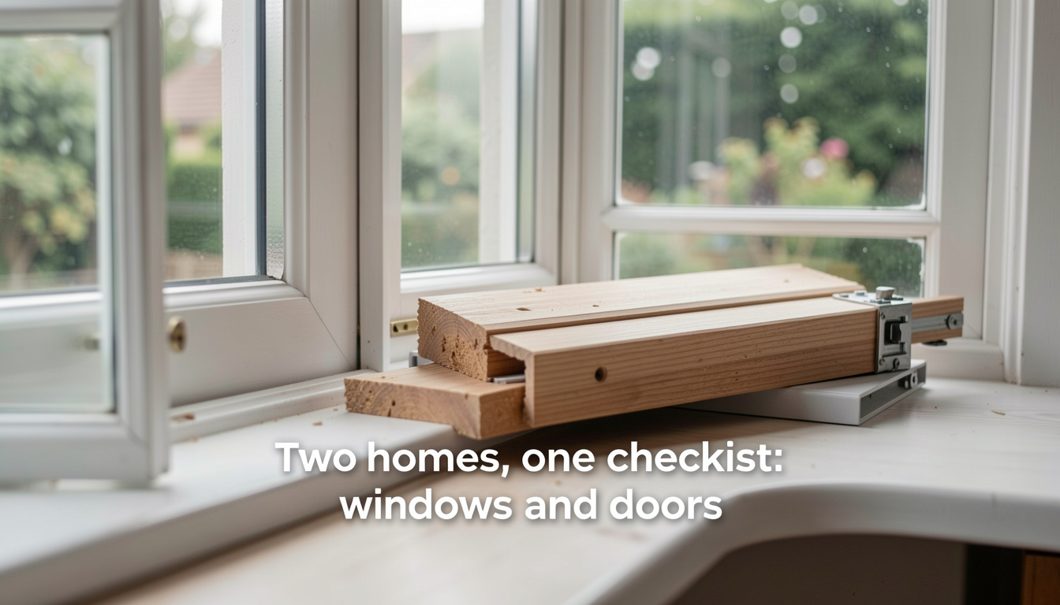
Two homes, one checklist: windows and doors
A family that runs between two houses has twice the glazing, twice the doors and twice the chance of a sticking frame going unnoticed. The seasonal checks are the same in both places; the trick is doing them on the same list.

01 How do you check a house you only see at weekends?
A part-time house tells you things in small signs: a sash that needs both hands, a door that catches on the same hinge every time, condensation inside the double glazing, a gutter spilling over at one corner. Each on its own is ignorable, which is exactly why they go unrecorded for a year.
The workable habit is a short fixed list run twice a year in each house, a spring pass and an autumn pass, written down, with the same headings in both homes so the two checklists can be compared line by line.
- Open and close every window and door once.
- Look for failed seals, draughts at the frames and condensation between panes.
- Check hinges, locks and the multi-point mechanism on the main doors.
- Walk the outside: gutters, fascias, anything dripping where it should not.
02 When does a sticking door become a replacement?
A sticking door is a hinge or a swollen frame until it is not: a multi-point lock that needs force, a door that has been planed twice, a frame with movement in it. The line is crossed when maintenance stops holding, and at that point the question becomes what to replace it with.
That comparison, composite against uPVC against timber and the security standards behind each, is a specialist subject of its own. A guide to comparing replacement doors, written for English homes, sets out the materials, the locks and the test standards in plain terms.
The same logic applies to windows: a failed sealed unit can be replaced without touching the frame, while warped timber or a draughty uPVC frame is the replacement conversation.
03 Which papers should each household keep?
Replacement windows and doors in England generate paperwork that matters later: the certificate for the installation, the guarantee for the units and frames, and the receipted invoice. When the house is sold or a fault appears, these are the documents asked for.
The installation certificate specifically confirms the work met building regulations; FENSA is the scheme that issues it, and a copy should live in each household's paperwork, not only in the house that paid for the work.
That folder is the same one described in family paperwork across two homes: one set of documents each household can reach, rather than a single file that is always in the wrong house.
04 Running the same checklist in both houses
The shared version is one heading list and two columns: what was checked, what was found, what was booked. It slots into the money conversation already described in budgeting for two households, because glazing work is exactly the kind of cost that arrives irregularly and argues badly at the doorstep.
And for the households for whom the second property is itself the open question, the bigger version of this thinking is in the second home question, asked properly.
More like this
Two homes