Out of the house
Indoor things to do in Exeter when it rains
Exeter is a good city to be rained on. Its main indoor places sit within a short walk of each other, and several of them hold children for longer than the forecast does.

On this page
- What is there to do indoors in Exeter when it rains?
- Why is the museum the best place to start?
- What are the Underground Passages, and who are they for?
- Is the cathedral worth visiting with children?
- Where can children use up energy indoors?
- Which quieter places suit a tired afternoon?
- How do you plan a wet Saturday across two homes?
- Questions readers ask about Exeter in the rain
Published 20 October 2026.
01 What is there to do indoors in Exeter when it rains?
The short answer is a walkable circuit. The Royal Albert Memorial Museum on Queen Street, the medieval Underground Passages off Paris Street and the cathedral sit within a short walk of each other in the middle of the city, and each holds a child's attention for a different reason. Add the climbing wall on the Quay, the pools at St Sidwell's Point and the children's library on Castle Street, and a wet Saturday has more indoor options than one day can use.
Exeter has been home to the Met Office since 2003, which is worth knowing for the child who asks why it always seems to rain here. The honest reply is that it does not, but when it does, the city centre is compact enough that nobody needs the car. A good coat, a plan with one fixed point and a short walk between dry places is the whole method.
This guide names places and says what is inside them. Like everything else in this section, it leaves out opening times and prices, which change faster than a magazine can follow: a look at each venue's own page on the morning saves the afternoon.
02 Why is the museum the best place to start?
The Royal Albert Memorial Museum and Art Gallery, known locally as RAMM, is run by Exeter City Council, and it is the natural place to build a wet day around. Its strength with children is pace. The galleries move from natural history to ancient Egypt to world cultures to the story of Exeter itself, so a short attention span is always arriving somewhere new.
The giraffe is the place to start. Gerald has been on display since 1920 and stands in the Case Histories gallery on the first floor, beside an African elephant. When the museum measured him with a laser in 2013, he came to 5.05 metres from his hooves to the tips of his ossicones, the horn-like knobs on top of his head. His height kept him inside the building through the redevelopment that ended in 2011, and at one point he spent a night in Northernhay Gardens behind the museum before a crane lowered him back in through the roof.
The Egyptian gallery, with the mummy and painted coffin of Shep en-Mut, is the room worth saving for the second half of a visit, when the first burst of energy has gone. The museum lists its current family events and trails on its own website, and they change through the year, so it is worth a look before setting out.
03 What are the Underground Passages, and who are they for?
Beneath the shops of the high street runs a network of medieval tunnels, built to bring clean water into the walled city from springs outside it. The water travelled through lead pipes, and the passages were vaulted so that a leaking pipe could be mended from inside rather than by digging up the street above. Survivals of this kind are rare in Britain, and parts of the network can be visited on a guided tour that starts from the visitor centre on Paris Street.
They are a very good hour for the right child and a poor one for the wrong child. Some stretches are tall enough to walk upright; others are narrow, low and closer to a scramble. Children who like a bit of atmosphere and a story about the city under their feet are the ones to bring. Children who dislike tight spaces, and the adults with them, should know about the low sections before booking.
04 Is the cathedral worth visiting with children?
Yes, as long as they have something to look for. Exeter Cathedral has no central tower, and because of that its stone vault runs unbroken from the west end of the nave to the east window. At about 96 metres it is the longest uninterrupted medieval vaulted ceiling in the world. Standing just inside the west door and looking along it is a good first thing to do with a child.
Then there is the clock. The astronomical clock in the north transept shows the hour and the phase of the moon, and its oldest part, the main lower dial, dates from 1484. In the door beneath it is a small round hole, cut in the early seventeenth century, so the story goes, to let the bishop's cat in to catch the mice drawn to the grease on the mechanism. Some people link it to the nursery rhyme about the mouse that ran up the clock. Nobody can prove it, and children do not mind.
The cathedral runs a Cat Trail for families, and its Treasures exhibition includes the Exeter Book, a tenth-century collection of Old English poetry that contains more than ninety riddles. Reading a translated riddle aloud the night before gives a child a reason to want to see the book. Look up as well at the minstrels' gallery in the nave, which dates from around 1360 and is unique among English cathedrals.
05 Where can children use up energy indoors?
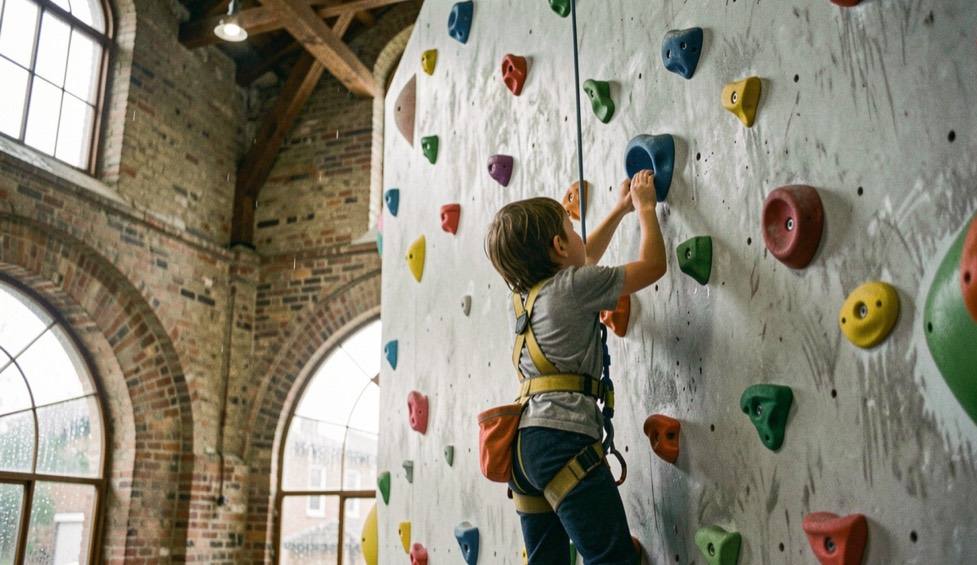
Museums are not the whole answer, and a child who has been still all morning needs to move. On the Quay, the Quay Climbing Centre occupies the old electricity building, put up in the early 1900s as the Haven Road power station, whose generators once ran the city trams. The main hall rises to around fifteen metres at its highest point. Alongside the roped walls for experienced climbers there are auto-belay climbs set up for younger children, which lower them gently back down when they let go.
Swimming is the other reliable outlet. St Sidwell's Point, the city centre leisure centre that opened in 2022, was the first leisure centre in the UK to be built to the Passivhaus standard. It has a main pool, a smaller learner pool and a confidence pool for children, along with a soft play area for the youngest. A swim followed by something hot to eat fills a wet morning without anybody noticing the weather.
06 Which quieter places suit a tired afternoon?
By the middle of the afternoon most children need somewhere calm. Exeter Library on Castle Street is the first answer. Its children's library was refitted and reopened in August 2025 as the Clore Children's Library, with a mezzanine and a sensory space designed for children with autism, ADHD and sensory processing needs. It is run by Libraries Unlimited, the charity that manages the public libraries of Devon and Torbay.
Up the hill at the university, the Bill Douglas Cinema Museum in the Old Library is one of the city's less known pleasures. It grew from the collection of the film-maker Bill Douglas and his friend Peter Jewell, given to the university after Douglas died in 1991. Its lower gallery holds the toys and machines that came before cinema: magic lanterns, shadow puppets and optical toys, among them a French praxinoscope from 1877. It is a good place to show a child how pictures were made to move long before screens.
Two smaller places complete the list. The Custom House on the Quay, built in 1680 and 1681 for the cloth trade, has been a visitor centre since 2015, with displays on that trade and a film that runs through the story of the city back to Roman times. Exeter Phoenix on Gandy Street, the city's arts centre, has galleries, a small cinema called Studio 74 and a family strand in its programme.
07 How do you plan a wet Saturday across two homes?
The rule that runs through rainy day outings in Devon holds in the city too: one indoor anchor in the middle of the day, and everything else kept loose around it. In Exeter the museum is the natural anchor, with the passages or the cathedral before it and the library after it, all on foot.
For a parent who has the children this weekend and not the next, the wet Saturday carries extra weight, and the temptation is to fill every hour. Resist it. One place in the morning, one in the afternoon and a long lunch in between is a full day for most children under ten, for the same reasons set out in keeping short visits simple.
The practical failures are nearly always kit. Waterproof trousers and a spare pair of socks make the walk from the museum to the cathedral pleasant rather than miserable, and they are exactly the things that get left in the other house. A set kept in each hallway, as on the shared week's duplication list, removes the problem. For the October and February breaks, when wet days tend to come in runs, planning half term across two homes covers the bigger decisions.
| Place | What holds a child | Suits | Worth knowing |
|---|---|---|---|
| Royal Albert Memorial Museum | Gerald the giraffe, the elephant, the Egyptian gallery | All ages | Build the day around it |
| Underground Passages | Medieval water tunnels under the high street | Older children who like atmosphere | Guided tour, narrow and low in places |
| Exeter Cathedral | The long vault, the clock and its cat hole | Children with something to look for | Ask about the Cat Trail |
| Quay Climbing Centre | Auto-belay walls in an old power station | Restless children | Check session times the night before |
| St Sidwell's Point | Learner pool, confidence pool and soft play | Swimmers and the very young | A swim fills a whole morning |
| Exeter Library | The Clore Children's Library and its sensory space | A tired afternoon | Central and calm |
| Bill Douglas Cinema Museum | Magic lanterns and optical toys | Children curious about how films work | On the university campus, up the hill |
08 Questions readers ask about Exeter in the rain
Short answers to the questions that come up when a wet weekend in the city is being planned.
- Is there enough to do indoors in Exeter for a whole wet day?
- Yes. The museum, the cathedral and the Underground Passages are a short walk apart in the city centre, and the library, the climbing wall on the Quay and the pools at St Sidwell's Point cover the rest. Most families will use two or three of them, not all.
- Which indoor places in Exeter suit young children best?
- For the under fives, the Royal Albert Memorial Museum and the children's library on Castle Street are the easiest: central, calm and full of things to look at. The Underground Passages suit older children better, because parts of the route are narrow and low.
- Do you need a car for a rainy day in Exeter with children?
- Not in the centre. The museum, the cathedral, the passages, the library and the Quay can all be reached on foot from one another, and the city has two main stations, Exeter St Davids and Exeter Central. The Bill Douglas Cinema Museum is on the university campus, a steeper walk up the hill.
More like this
Family life in Devon