The shared week
Handovers that work between two homes
Handovers are short, frequent and emotionally loaded, which makes them the highest leverage four minutes in a shared family.
On this page
Published 11 August 2026.
01 Where to do it
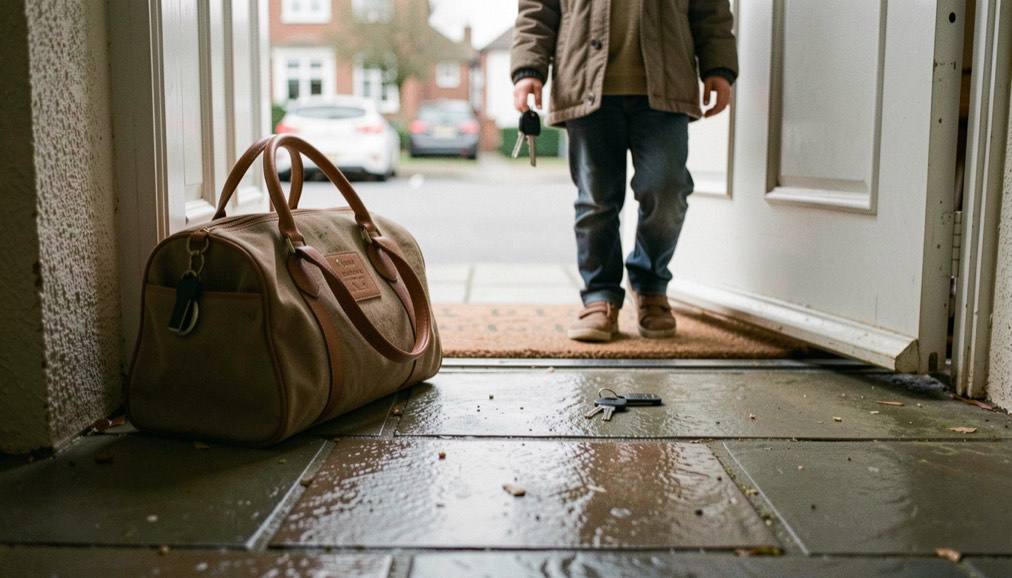
The doorstep is the default and it is fine once the arrangement is settled. It is short, it is familiar, and the child moves from one home to the other without an intermediate stage.
A neutral place works better while things are still raw, and school works better still where the timetable allows it, because the child simply goes in from one home and out to the other. No doorstep, no waiting car, no adults in the same frame.
Whatever is chosen, keep it the same. Predictability is doing most of the work here. Changing the location for convenience costs more than the convenience is worth.
02 Keep it to four minutes
Long handovers are almost always adult business conducted in front of a child. Four minutes is enough to pass on what matters: what has been eaten, what is in the bag, what is happening midweek, anything a school has asked for.
Everything else goes into a written message later. That is not coldness; it is a separation of jobs. The doorstep is for the child. The message is for the adults. Households that keep those apart find both improve, and the reasoning is unpacked in messages between two homes.
A useful test: if the sentence you are about to say would be awkward to write down and send, it is the wrong sentence for a doorstep.
03 The three sentences that help
The first is a factual handover line, said to the other adult in front of the child: what has been eaten, what is in the bag, what is on this week. It is boring on purpose and it tells the child that information travels between the two homes reliably.
The second is permission, said to the child: some version of "have a good week, I will see you Friday". Clear, warm and finite. It gives the child a date to hold on to and removes the question they were about to ask.
The third is the one most often forgotten, said to the child on arrival rather than departure: "you are back, put your bag down, tea is at six". Arrival needs marking as much as departure does, and it is the point at which a child works out whether the house has been waiting for them.
- Say the factual line to the other adult, in front of the child.
- Say goodbye warmly and briefly, with the next date in it.
- Mark the arrival at the other end with an ordinary instruction.
04 When a handover goes badly
Children sometimes refuse, cry, cling or go silent, and it rarely means what the adults immediately assume. Tiredness, hunger, a bad afternoon at school and the ordinary friction of transition account for most of it. A child who was distraught at five past six is very often absorbed in something by half past.
Do not analyse it on the doorstep and do not ask the child to explain themselves in front of both adults. Note what happened, mention it in a message the next day, and see whether it repeats. Three times is a pattern; once is a Tuesday.
If it does become a pattern, the useful next step is to change one variable: the time, the place, the day, or what happens in the hour before. There is more on drawing children out afterwards in asking children how it is going.
More like this
Co-parenting