From their side
Screen time that works across two homes
Screens are the commonest proxy argument between two households, which is a shame, because the parts that matter are not the parts people argue about.
01 Why it becomes a proxy argument
Screen rules are visible, easy to compare and easy to feel strongly about, which makes them an ideal vehicle for a disagreement about something else entirely. A household that is annoyed about lateness will find itself annoyed about a tablet.
The test is simple. If the concern would survive being written down as a factual observation with a date, it is a real concern. If it only makes sense as part of a broader complaint, it is a proxy, and the useful conversation is a different one.
Real screen concerns do exist: sleep, content, cost and isolation. Those are worth raising, in the format described in messages between two homes.
02 What actually matters
Sleep matters. A screen in a bedroom after lights out costs a child more than an extra hour on a Saturday afternoon ever will, and it is the one rule worth aligning between two houses even when nothing else is aligned.
Content matters, particularly for younger children and particularly for anything with a chat function attached. Cost matters, because in app purchases are designed to be invisible to the adult paying for them.
Whether a child watched two hours or three on a wet Sunday does not matter very much, and treating it as though it does spends credibility that will be needed for the things that do.
- Align the bedroom and bedtime rule, even if nothing else is aligned.
- Know what is being watched and whether it has a chat function.
- Turn off purchasing on every device in both homes.
- Stop counting hours on wet Sundays.
03 Watching together is a different thing
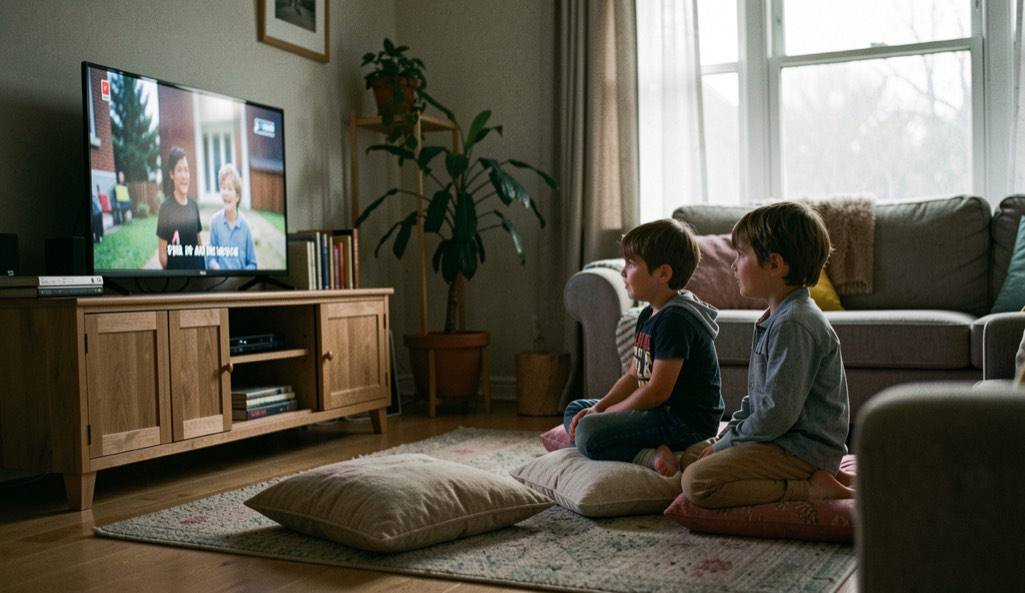
A child alone with a tablet and a family watching something together are not the same activity and should not be counted in the same budget. Shared viewing is sociable, it generates conversation, and it gives a short visit a shape without requiring anyone to be entertaining.
A film on a Friday evening is one of the more reliable ways to make a house feel like home again after a week away, particularly for children who take a while to settle. It works better with a fixed slot than as a fallback.
For families that see each other in short bursts, a series watched together over several visits creates continuity between them, which is the same principle as the half finished jigsaw in things to do with children on short visits.
04 Devices, chargers and the practical layer
Half of all screen arguments in a shared family are actually about a charger. A cable in each house, permanently, removes a recurring irritation for the price of a sandwich.
Agree who buys and who supplies devices, and write it into the shared list described in budgeting for two households. Devices are expensive enough to be worth naming explicitly.
For older children, the useful conversation is about where the device lives at night rather than how long it is used. That single rule does most of the work and is easy to keep in both houses.
Passwords and accounts are the last piece and the one most often left undone. Both households should be able to unlock a device belonging to a younger child, and both should know which accounts exist. This is a practical matter rather than a question of trust, and it is far easier to sort out on a quiet Sunday than in the middle of the week when something has gone wrong.
More like this
Children and change